Earned value management is a measurement of results against efforts.
Earned value is useless if not bound to a daily production target which must be determined in advance.
Earned Value Analysis compares the performance measurement baseline to the actual schedule and cost performance at different times during the project. Earned Value integrates the three (3) main project constraints SCOPE, COST and SCHEDULE to provide an indication of planned vs actuals and provides insight for the future if trend remains the same. The purpose of earned value management is to understand if the level of expenditure matches with the planned and time phased cost baseline, and to determine variances and trigger necessary corrective actions. Earned value is useless in projects with very little detail in advance and only useful if realistic planning has been developed in advance.
Earned Value in Project Cost Management
Understanding of concepts to maximize use and benefit of a process
Planned Value (PV): Is the authorized budget assigned to scheduled work for each activity, work package or project not including management reserves. PV is the defined budget for a determined activity, installation work package or work package summarized in the cost baseline and ECR (Column Budget Grant Total). The total planned value for the project is called BAC, budget at completion. PV units are always dollar ($). A way of simplifying this concept is to imagine PV as planned budged/cost for each activity. The graphic demonstrates how PV is the reference point for the project.
Actual Cost (AC): Is the realized cost incurred for the work performed on each activity during a specific time and period. AC is the incurred expenditure for a determined activity, installation work package or work package summarized with the ECR (Column JDT Total Cost). The AC needs to correspond in definition to what was budgeted in PV (e.g direct hours only, indirect cost only, or all cost included together). AC units are always dollar ($).
Earned Value (EV): Is a measure of work performed expressed in terms of usage of the budget authorized for that work. EV is a numeric index and does not have units.

The graphic above examines the planned value (PV) at a given point in time against the actual cost (AC) and the earned value (EV). It is important to compare against the cost baseline (PV) and not assume a linear cost based on time such as 50% spending at 50% of the project is acceptable progress and spending. The next figure below clearly shows that this assumption can be very misleading and lead to wrong conclusions and decisions which will negatively impact the outcome of the project.
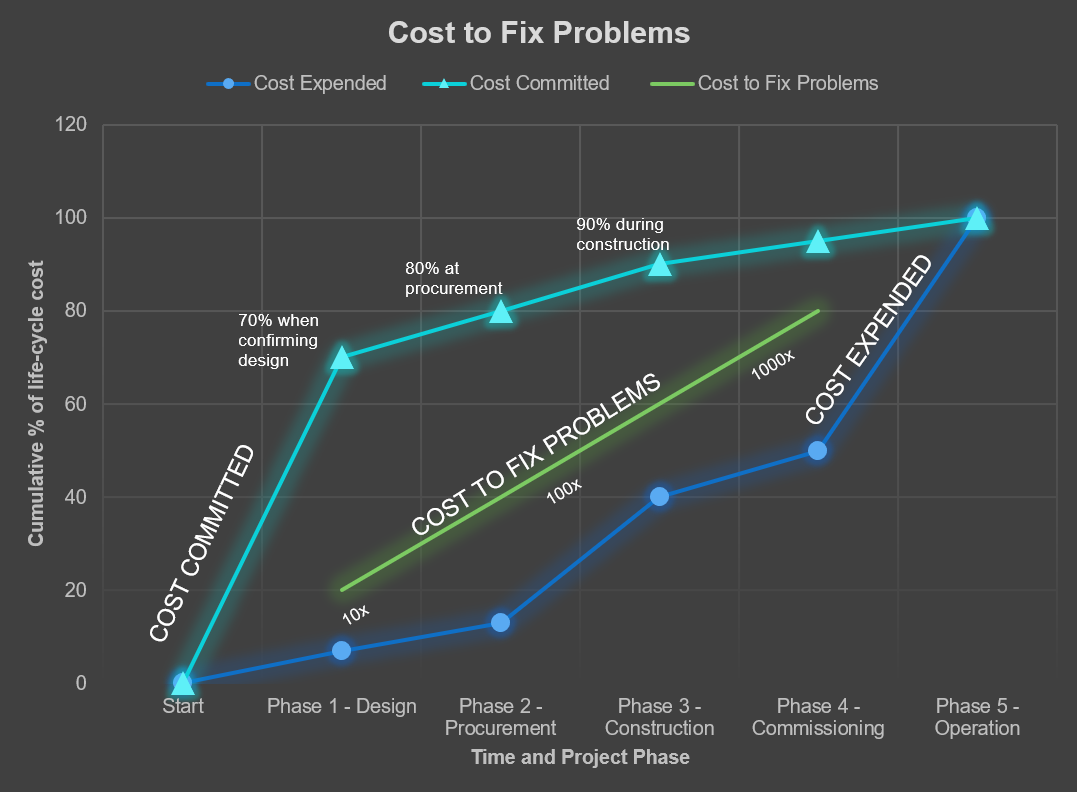
Disregard the Earned Value Management, a experienced and knowledgeable project manger should never rely on this data alone to forecast the project. The figure above outlines how project cost can grow exponentially the closer the project comes to its final completion.
For example: The discovery of a design mistake due cost saving during the design phase on a vacuum skid resulted in a full stop during the final commissioning phase of a project causing and expense >10 times higher than the original cost of purchase of the equipment.
Earned Value parameters
The degree and detail of earned value management varies from project to project, but all projects should report at least following parameters:

Actual Cost (AC)
Is the realized cost incurred for the work performed on an activity during a specific time period. Usually considers cost up to a certain date.
Earned Value (EV)
The measure of work performed expressed in terms of the budget authorized for that work. Planned value of all work completed (earned) to a point in time.
Cost Variance (CV)
Cost Variance is the amount of budget deficit or surplus at given point in time, expressed as the difference between the earned value and the planned value. It is calculated as the difference between the value of work completed to a point in time , usually data to date vs the actual incurred and committed cost to the same point in time.
Formula: CV=EV-AC
positive = under planned cost
neutral = in planned cost
negative = over planned cost
Variance at Completion (VAC)
Variance at Completion is a projection of the amount of budget deficit or surplus, expressed as the difference between the budget at completion and the estimate at completion. It is calculated as the estimated difference in cost at the completion of the project.
Formula: VAC=BAC-EAC
positive = under planned cost
neutral = in planned cost
negative = over planned cost
Cost Performance Index (CPI)
The Cost Performance Index is a measure of cost efficiency of budgeted resources expressed as the ratio of earned value to actual cost. A CPI of 1.0 means the project is exactly on budget and that the work done so far is exactly the same as the cost so far. Other values show the percentage of how much costs are over or under the budgeted amount for work accomplished.
Formula: CPI=EV/AC
greater than 1.0 under planned cost
exactly 1.0 on planned cost
less than 1.0 over planned cost
Cost Performance Index (CPI) should not be mixed up with the often used Performance Factor (PF) in estimating or reporting. The performance factor is a measure of efficiency between the estimated hours vs the actual incurred hours. Although hours spend vs hours planned can give a sense of cost performance, it is not the correct parameter to determine CPI. The correct parameter is total planned value to date vs total cost committed and incurred to date.
Estimated at Completion (EAC)
The expected total cost of completing all work expressed as the sum of the actual cost to date and the estimate to complete.
Formulas:
EAC=BAC/CPI (most common used to determine individual tasks, last formula should be used for whole project)
EAC=AC+BAC-EV (If future work will be accomplished at the planned rate)
EAC=AC+Bottom-up ETC (If the initial plan is no longer valid)
EAC=AC+((BAC-EV)/(CPIxSPI))(If both the CPI and the SPI influence the remaining work. Preferred method if CPI and SPI are reliable and accurately reported.
To Complete Performance Index (TCPI)
The TCPI is a measure of the cost performance that must be achieved with the remaining resources in order to meet a specified management goal, expressed as the ratio of the cost to finish the outstanding work to the budget available.
Formulas:
TCPI=(BAC-EV)/(BAC-AC) The efficiency that must be maintained in order to complete on plan.
TCPI=(BAC-EV)/(EAC-AC) The efficiency that must be maintained in order to complete the current EAC.
greater than 1.0 harder to complete
exactly 1.0 same to complete
less than 1.0 easier to complete
Budget at Completion (BAC)
The Budget at Completion (BAC) is the sum of all budgets established for the work to be performed, or also the value of the total planned work.
All definitions of earned value management:

Earned Value misconstructions
Earned Value shall never be confused by the project team with:
Rules of Credit
Define monetary compensation based on progress, and example is placing of equipment is equivalent of 30% payment progress due the high equipment cost, but in terms of effort required only few hours.
Weighted Milestones
Weighted Milestones: Define progress based on percentage complete, often assumed on a subjective base. Usually progress is only updated and logged once certain milestones has been achieved which then in turn corresponds to a predetermined percentage of progress. Examples are 5% progress to bring materials from the laydown area to the Workfront. This can be linked to estimated hours or not.
Direct Workforce Hours
Use the actual hours vs the planned hours as measure of EV. This is Schedule Earned Value and not Cost Earned Value

How to implement earned value management
The step towards productivityEarned value management is not an earning for effort expended. It is an earning for results gained. [...]